
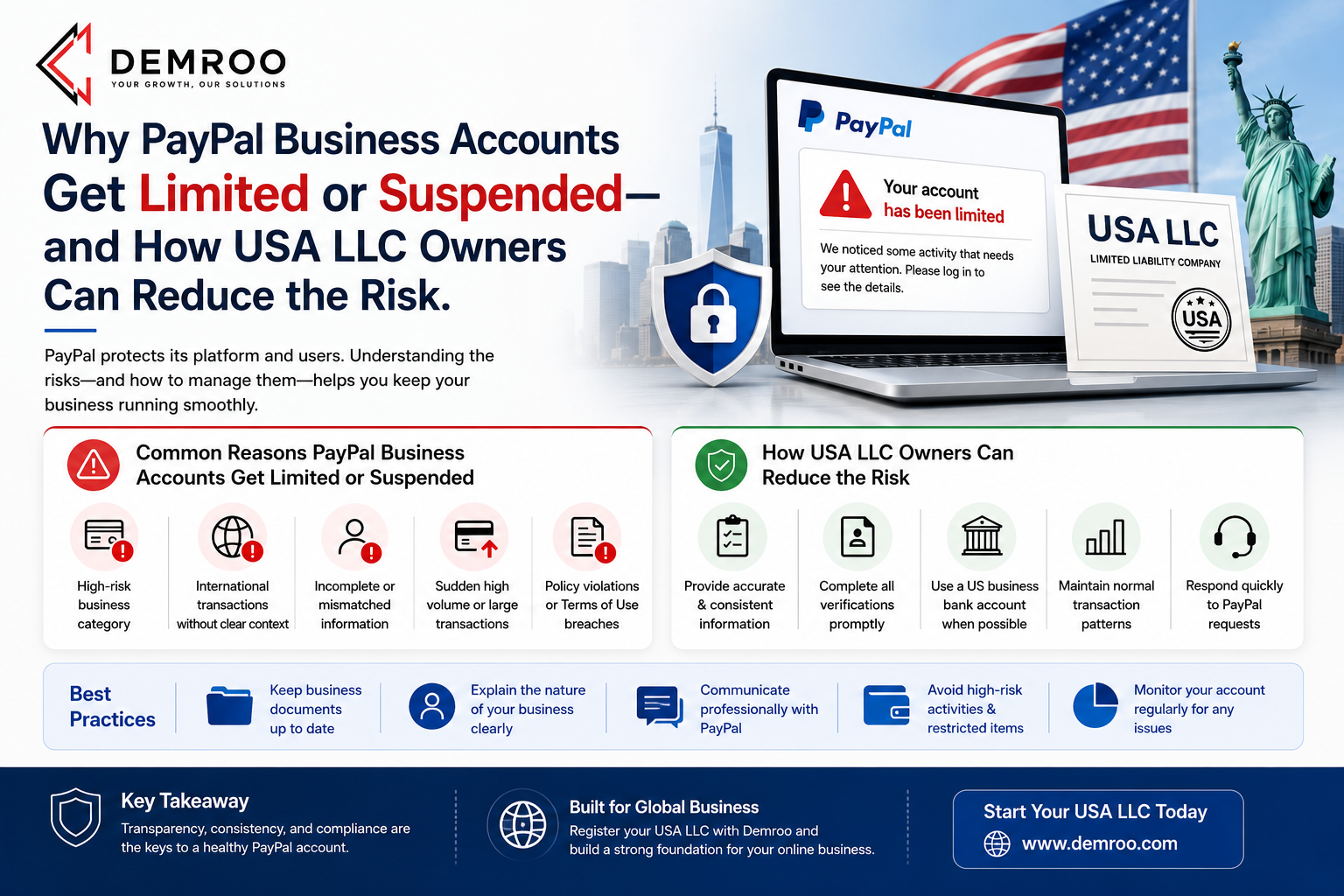
A PayPal Business account can help a USA LLC accept online payments, send invoices and serve international customers. However, PayPal may restrict certain account functions when it detects unusual activity, requires additional verification or identifies increased financial or regulatory risk.
A limitation does not always mean that the account has been permanently closed. In many cases, PayPal asks the account holder to confirm their identity, business information, transactions or fulfilment process.
During a limitation, the business may temporarily lose the ability to:
- Receive payments
- Send money
- Withdraw funds
- Add or remove a bank account
- Process refunds
- Close the account
- Access certain PayPal products
The impact can be particularly serious for a non-US resident operating through a USA LLC because the owner must ensure that the company, tax, banking, address and personal identity records are complete and consistent.
Quick answer: PayPal may limit a Business account because of regulatory requirements, identity-verification issues, restricted business activity, unauthorized access, sudden sales growth, excessive disputes or information that does not match the company’s documents.
If you are still preparing your account, read Demroo’s guide on opening a PayPal Business account with a USA LLC.
What Is a PayPal Account Limitation?
A PayPal account limitation is a restriction that prevents the user from completing one or more account activities.
A limitation may be temporary while PayPal reviews information, or it may become permanent if the account is no longer eligible for PayPal’s services.
PayPal distinguishes between three related actions:
| ActionMeaningPossible effect | ||
| Account limitation | Certain account functions are restricted | Sending, receiving or withdrawing may be unavailable |
| Payment hold | A particular payment is temporarily unavailable | The transaction remains pending |
| Account reserve | PayPal keeps part of the account balance unavailable | A percentage or minimum balance may be retained |
| Account suspension or closure | Access to PayPal services is discontinued | The account may no longer process payments |
These actions are not identical. A payment hold may affect only one transaction, while an account limitation can affect multiple account functions.
Why Does PayPal Limit Business Accounts?
PayPal states that limitations may be introduced because of regulatory requirements, Acceptable Use Policy issues, unauthorized use, higher-risk activity or inactivity. High claims and chargebacks, rapid growth and a major change in products can also trigger a review.
1. Identity or business information cannot be verified
PayPal may need to confirm:
- The legal identity of the account holder
- The company’s legal name
- Employer Identification Number
- Beneficial ownership
- Business address
- Owner’s residential address
- Linked bank account
- Nature of the business
- Source of funds
- Products or services being sold
A limitation may occur when the information entered in PayPal does not match the submitted documents.
For example, a company could face verification difficulties if:
- Its LLC name is different from its EIN record
- The bank account belongs to another person
- The website displays a different business name
- The owner enters a mailing address as a residential address
- The PayPal profile contains an outdated address
- The business category does not match the website
If you have not completed your business registration, explore Demroo’s USA LLC formation service.
2. Sudden increase in payment volume
A new PayPal account that normally receives $500 per month may trigger additional checks if it suddenly receives $20,000 in a few days.
Rapid growth is not automatically a violation, but PayPal may review whether the business can fulfil its orders and manage potential refunds, disputes or chargebacks.
Businesses expecting a major increase in sales should maintain:
- Supplier agreements
- Product inventory records
- Customer contracts
- Fulfilment evidence
- Shipping tracking
- Marketing campaign information
- Proof of available working capital
3. High number of disputes or chargebacks
A high dispute rate can indicate customer dissatisfaction or fulfilment problems.
Common causes include:
- Products not delivered
- Services not completed
- Misleading advertising
- Unclear billing descriptors
- Unauthorized recurring payments
- Poor customer support
- Unexpected subscription renewals
- Products that differ from their descriptions
- Slow refunds
PayPal considers customer disputes, chargebacks, returns and delivery timeframes when evaluating account risk.
4. A significant change in products or business model
An account originally created for web-design services may be reviewed if it suddenly begins processing high-value jewellery sales, event tickets or another unrelated product category.
Update the business information when there is a genuine change in:
- Products or services
- Average transaction value
- Sales volume
- Customer location
- Business website
- Fulfilment timeframe
- Ownership
- Company address
The PayPal profile should accurately represent the business’s current operations.
5. Selling prohibited or restricted products
PayPal’s Acceptable Use Policy restricts or prohibits various activities. Some business models require prior approval, while others may not be supported.
Higher-risk or restricted categories may include certain:
- Financial services
- Cryptocurrencies
- Gambling activities
- Adult-oriented services
- Medicines and healthcare products
- Weapons
- High-risk investments
- Copyright-infringing products
- Multi-level marketing models
- Products making misleading claims
Businesses should review the latest Acceptable Use Policy before opening an account or introducing a new product line.
6. Unauthorized or suspicious account access
PayPal may restrict an account if it suspects that someone else has accessed it.
Potential security signals can include:
- Login from an unfamiliar device
- Unusual location or IP address
- Repeated failed login attempts
- Unexpected bank-account changes
- New payment activity inconsistent with prior use
- Card issuer reporting unauthorized activity
A limitation in this situation may be intended to protect the account holder from loss.
7. Inconsistent address information
Address inconsistencies are a common concern for international LLC owners.
A business may have several legitimate addresses:
- Registered agent address
- Principal business address
- Mailing address
- Owner’s residential address
- Bank correspondence address
- Returns address
These addresses serve different purposes. Do not enter a registered agent or virtual mailing address as the owner’s residential address.
If the LLC requires a dedicated location for receiving correspondence, learn about Demroo’s unique US mailing address service. Address acceptance remains subject to PayPal’s requirements.
8. Problems with the linked bank account
PayPal may review or restrict activity when:
- The bank-account name does not match the LLC
- A withdrawal repeatedly fails
- The bank reports unauthorized transfers
- The account is closed
- The routing details are incorrect
- The bank account belongs to an unrelated party
- The account cannot support the relevant transactions
The safest approach is to use a compatible business bank account opened under the LLC’s correct legal name.
Demroo provides US business bank account setup assistance for eligible companies.
9. Incomplete or misleading website
PayPal may examine the website to understand the business and assess fulfilment risk.
A credible website should include:
- Correct legal or trading name
- Clear description of products or services
- Transparent pricing
- Contact details
- Refund policy
- Cancellation policy
- Privacy policy
- Terms and conditions
- Shipping or delivery policy
- Expected fulfilment period
- Subscription terms, if applicable
Generic content or an unfinished website can make it difficult to verify the business model.
10. Opening another account to bypass a limitation
Creating a new PayPal account to avoid an existing restriction can create further problems.
PayPal’s current US User Agreement prohibits attempting to bypass limitations by opening additional accounts, using information belonging to someone else or using another person’s account.
Always address the original limitation through the PayPal Resolution Center.
Why Does PayPal Place Payments on Hold?
A payment hold is different from a complete account limitation.
PayPal may place a temporary hold on payments when:
- The seller is new
- The account has limited selling history
- The transaction appears unusual
- The product category has higher risk
- Customer disputes have increased
- Fulfilment cannot be confirmed
- The account receives a payment much larger than usual
Under PayPal’s current US User Agreement, risk-based holds generally remain in place for up to 21 days, although the actual release depends on the situation and applicable requirements.
Adding accurate shipping tracking or fulfilment information may help PayPal confirm that the customer received the order. It does not guarantee immediate release.
What Is a PayPal Reserve?
A reserve is money that PayPal keeps temporarily unavailable to help cover potential disputes, chargebacks or reversals.
Rolling reserve
PayPal holds a percentage of each payment and releases it later according to the reserve schedule.
For example, if the reserve is 10% for 90 days, PayPal could retain 10% of each eligible transaction and release it after the applicable 90-day period.
Minimum reserve
The business must keep a specified minimum balance in its PayPal account.
PayPal may establish a reserve based on factors such as:
- Business model
- Transaction volume
- Average order value
- Delivery period
- Chargeback rate
- Credit history
- Sales history
- Previous account activity
- Industry risk
A reserve is not necessarily permanent. PayPal may review its terms as the business’s risk profile changes.
What Documents Can PayPal Request?
PayPal may request additional business information when it detects changes in selling patterns or increased buyer complaints. This can include supplier details, invoices and bank statements.
Possible verification documents include:
| Verification requirementPossible supporting document | |
| Personal identity | Passport or eligible government-issued ID |
| Residential address | Bank statement, utility bill or government correspondence |
| Business identity | LLC formation document |
| Tax identification | IRS EIN confirmation letter |
| Business address | Eligible bank statement or official company document |
| Bank ownership | Business bank statement |
| Product sourcing | Supplier invoice or agreement |
| Customer transaction | Invoice, contract or order record |
| Fulfilment | Shipping tracking or proof of service completion |
| Business activity | Website, contracts and recent account statements |
Only provide the documents specifically requested in the Resolution Center.
Documents should be:
- Current
- Complete
- Clear and readable
- Unedited
- Unexpired
- Visible on all four corners
- Consistent with the PayPal account information
How to Remove a PayPal Account Limitation
Step 1: Log in directly to PayPal
Do not click a link in an unexpected email.
Open PayPal directly in your browser and check:
- Resolution Center
- Dashboard notifications
- Message Center
- Account alerts
If an email claims that the account is limited but no corresponding alert appears inside PayPal, it may be a phishing attempt.
Step 2: Identify every requested action
PayPal may ask the account holder to:
- Confirm identity
- Verify an address
- Upload business documents
- Explain transactions
- Provide supplier invoices
- Confirm fulfilment
- Link or verify a bank account
- Resolve a negative balance
- Update company information
Complete every displayed requirement.
Step 3: Match the documents with the account
Check the spelling of:
- Owner’s full name
- LLC legal name
- EIN
- Residential address
- Business address
- Bank account holder
Do not alter documents to force a match. Correct inaccurate PayPal information through the appropriate process.
Step 4: Explain the business model clearly
A useful explanation should answer:
- What does the company sell?
- Who are its customers?
- What is the average transaction value?
- How are orders delivered?
- How long does fulfilment take?
- What caused the increase in sales?
- How are refunds and disputes managed?
Avoid vague descriptions such as “online business” or “consulting services.”
Step 5: Submit the documents through the Resolution Center
Use PayPal’s official upload system. Do not send sensitive documents to an unverified email address.
According to PayPal, completing the requested steps does not always remove a limitation immediately. The account may remain under review or PayPal may request additional information. Resolution time depends on the complexity of the case.
Step 6: Monitor your email and PayPal account
PayPal may send:
- Confirmation of document receipt
- A request for more information
- A decision about the limitation
- Instructions for another verification step
Respond within the requested deadline.
How USA LLC Owners Can Reduce Limitation Risk
Keep every record consistent
The LLC name, EIN, bank account, website and PayPal profile should display consistent company details.
Use the owner’s genuine identity
Use the beneficial owner’s real name, date of birth, residential address and government-issued identification.
Never use:
- Someone else’s SSN
- Borrowed identity documents
- A fake US residence
- An unrelated bank account
- Edited utility bills
- Purchased or rented PayPal accounts
Build a complete website before applying
Publish all essential business and customer policies before receiving payments.
Start with reasonable transaction volume
Do not attempt to manufacture account history or process fake transactions. Begin with genuine customer activity and maintain evidence for every sale.
Communicate realistic delivery times
If a product takes 20 days to deliver, do not advertise three-day delivery.
Upload tracking promptly
For physical products, use reliable shipping services and add valid tracking details.
Maintain a refund reserve
Keep enough working capital outside PayPal to manage refunds, advertising, operations and fulfilment if funds are temporarily held.
Monitor disputes
Reply quickly to customers and try to solve genuine concerns before they become chargebacks.
Prepare documents in advance
Maintain an organized folder containing:
- LLC formation certificate
- EIN letter
- Operating agreement
- Owner identification
- Bank statements
- Supplier invoices
- Customer contracts
- Proof of delivery
- Tax and compliance records
Can Demroo Guarantee PayPal Approval?
No service provider can guarantee that PayPal will approve an account, remove a limitation or release funds.
PayPal makes its own compliance and risk decisions.
A professional service can help a business:
- Register its LLC correctly
- Obtain an EIN
- Prepare business records
- Establish suitable banking arrangements
- Configure a payment gateway
- Improve website readiness
- Maintain consistent information
For setup assistance, explore Demroo’s payment gateway setup service.
Frequently Asked Questions
Why has PayPal suddenly limited my Business account?
PayPal may limit an account because of regulatory requirements, unusual activity, identity-verification needs, a rapid increase in sales, high disputes, restricted products or security concerns.
Can I still receive money when my PayPal account is limited?
It depends on the type of limitation. Some limitations affect only withdrawals, while others prevent sending, receiving or withdrawing money. Check the Resolution Center for the exact restrictions.
How long does PayPal take to remove a limitation?
There is no universal timeframe. The review period depends on the reason, complexity and completeness of the submitted information.
Can I open another PayPal account after a limitation?
Do not open another account to bypass an existing limitation. Follow the instructions for the original account through the Resolution Center.
Why is PayPal asking for supplier invoices?
PayPal may request invoices to confirm that the business has a genuine source for the products it sells and can fulfil customer orders.
Can PayPal permanently limit a USA LLC account?
Yes. PayPal may permanently restrict an account when it determines that the account is ineligible, presents unacceptable risk or violates its agreements or policies.
Does a USA LLC prevent PayPal limitations?
No. LLC formation creates a legal business entity but does not prevent transaction holds, reserves, verification requests or account limitations.
Can PayPal hold funds for 180 days?
Under applicable PayPal agreements, funds associated with certain violations or potential liabilities may be held for up to 180 days, and sometimes longer where required by legal or regulatory processes. The applicable agreement and individual account notice should be reviewed carefully.
Will changing my business address remove the limitation?
Not automatically. Only update the address if the existing information is inaccurate, and provide genuine supporting documents when requested.
Conclusion
PayPal Business accounts may be limited because of verification requirements, unusual activity, higher financial risk, customer disputes, prohibited products or inconsistencies in company information.
For non-US owners of USA LLCs, the best preventive strategy is to establish the business correctly and maintain transparent records from the beginning.
The company’s formation documents, EIN, bank account, website, business description and PayPal profile should tell the same clear and truthful story.
If a limitation occurs, do not panic, create another account or submit altered documents. Check the Resolution Center, complete every requested step and provide clear evidence of identity, ownership, transactions and fulfilment.
For assistance with USA LLC formation, EIN registration, business bank account setup and payment gateway setup, contact Demroo.
Disclaimer: This article provides general educational information and does not constitute legal, tax, banking or financial advice. PayPal policies and account requirements may change. PayPal alone determines account eligibility, limitations, reserves and fund availability.
Key Takeaways
- A PayPal limitation can restrict receiving, sending or withdrawing funds.
- Limitations can result from verification, risk, security or policy issues.
- Sudden sales growth and high dispute rates can trigger additional review.
- USA LLC registration does not guarantee unrestricted PayPal access.
- Business, identity, address, bank and tax information should remain consistent.
- Never use false documents or create another account to bypass a restriction.
- Submit requested information only through PayPal’s official Resolution Center.
- Maintain backup working capital in case payments are temporarily held.