
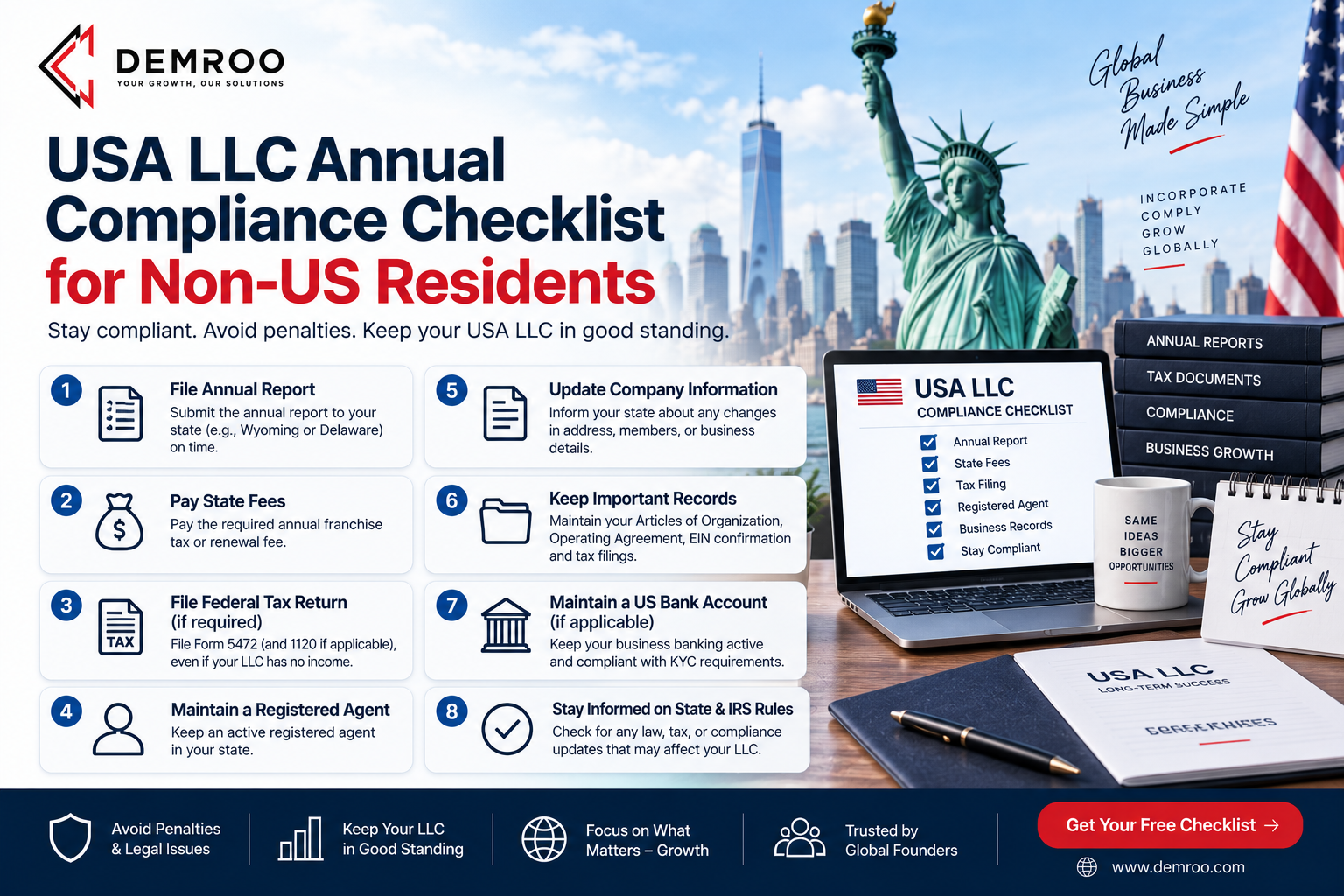
Forming a USA LLC is only the first step. To keep the company active and in good standing, a non-US owner must complete applicable federal, state and business compliance requirements every year.
These obligations may include filing a state annual report, maintaining a registered agent, paying state fees, submitting federal information returns and keeping accurate records of transactions between the LLC and its foreign owner.
One of the most commonly misunderstood requirements applies to a foreign-owned single-member LLC. Even when the LLC does not owe US federal income tax, it may still need to file Form 5472 with a pro forma Form 1120 if it had a reportable transaction with its foreign owner or another related party.
Missing a required Form 5472 can result in a significant IRS penalty. Foreign founders should therefore understand their compliance responsibilities before accepting payments or transferring money through the company.
Quick answer: A non-US resident’s USA LLC may need to maintain a registered agent, file a state annual or biennial report, pay state fees, submit applicable federal tax or information returns and keep detailed financial records. Exact requirements depend on the state, ownership structure, tax classification and business activity.
If you have not registered your company yet, review Demroo’s USA LLC formation service.
What Does USA LLC Compliance Mean?
USA LLC compliance refers to the filings, payments, records and administrative responsibilities required to keep a limited liability company legally active.
An LLC can have multiple levels of compliance:
- State business compliance
- Federal tax compliance
- State and local tax compliance
- Registered-agent compliance
- Licensing and permit requirements
- Employment compliance
- Banking and payment-provider verification
- Recordkeeping requirements
- Home-country tax and reporting obligations
Registering an LLC does not automatically complete these responsibilities. Most requirements continue for as long as the company legally exists, even if the business has little revenue or is temporarily inactive.
USA LLC Annual Compliance Checklist
The following table provides a general overview for non-US LLC owners.
| Compliance requirementWho may need it?Usual frequency | ||
| State annual or biennial report | LLCs registered in states that require it | Annual or every two years |
| State annual fee or franchise tax | Depends on formation and operating states | Usually annual |
| Registered agent renewal | Almost every active LLC | Continuous or annual service renewal |
| Form 5472 with pro forma Form 1120 | Certain foreign-owned US disregarded entities with reportable transactions | Annual |
| Partnership return—Form 1065 | LLCs generally taxed as partnerships | Annual |
| Corporate tax return | LLCs that elect or receive corporate tax treatment | Annual |
| State income or business tax return | Depends on state activity and tax rules | Annual or periodic |
| Sales tax returns | Businesses registered for sales tax | Monthly, quarterly or annual |
| Payroll returns | LLCs with employees | Quarterly and annual |
| Business licence renewal | Regulated or locally licensed businesses | Varies |
| Accounting and transaction records | Every LLC | Ongoing |
| Beneficial ownership reporting review | Entities covered by current FinCEN rules | When applicable |
This checklist is general. Not every requirement applies to every LLC, and additional obligations may apply.
Maintain a Registered Agent
An LLC must generally maintain a registered agent in its state of formation.
The registered agent receives:
- Legal notices
- Service of process
- State correspondence
- Compliance notices
- Documents related to lawsuits
- Certain tax communications
The registered agent must normally have a physical street address in the state and be available during standard business hours.
A non-US founder does not usually need to live in the formation state. The owner can appoint a professional registered agent service.
If an LLC loses its registered agent or the agent resigns without a replacement, the company may lose good standing and eventually face administrative dissolution.
The registered agent’s address should not automatically be treated as an operational or banking address. These addresses perform different functions.
File the State Annual or Biennial Report
Many states require an LLC to submit an annual or biennial report. The name of this filing varies by state and may include:
- Annual report
- Biennial report
- Periodic report
- Annual registration
- Information report
- Statement of information
The report typically confirms or updates:
- LLC legal name
- Principal office address
- Mailing address
- Registered agent details
- Member or manager information
- Business activity
- Contact email
- Authorized representatives
Not every state follows the same schedule. Some deadlines are based on the company’s formation anniversary, while others use a fixed date or a particular month.
For example, an LLC formed in one state may have an annual report deadline based on its formation month, while an LLC in another state may have a different recurring deadline.
Owners should check the official Secretary of State or equivalent business-registration website for the state where the LLC was formed.
Pay State Fees and Franchise Taxes
An annual report filing fee is not always the only state-level cost.
Depending on the state, an LLC may also owe:
- Annual registration fee
- Franchise tax
- Business privilege tax
- Minimum state tax
- State income tax
- Gross receipts tax
- Local business tax
- Licence renewal fee
A franchise tax is generally a charge imposed for the privilege of maintaining or conducting business in a state. It may apply even when the LLC has little or no profit.
Non-US owners should not select a state based only on its initial formation fee. The total long-term cost includes annual filings, registered-agent service, taxes and possible foreign qualification in other states.
Understand Form 5472 for a Foreign-Owned LLC
Form 5472 is an IRS information return used to report certain transactions involving a reporting corporation and a foreign or domestic related party.
For this purpose, a foreign-owned US disregarded entity can be treated as a corporation for limited reporting requirements under Internal Revenue Code Section 6038A.
According to the IRS Instructions for Form 5472, a foreign-owned US disregarded entity that has a reportable transaction must generally file:
- A pro forma Form 1120, and
- Form 5472 attached to that pro forma return.
This filing may be required even when the single-member LLC does not otherwise have a federal corporate income tax return requirement.
What Is a Foreign-Owned US Disregarded Entity?
A foreign-owned US disregarded entity is generally a domestic entity that is:
- Wholly owned by a foreign person, and
- Disregarded as separate from its owner for US federal income tax purposes.
A common example is a single-member USA LLC wholly owned by an individual residing in India that has not elected to be taxed as a corporation.
“Disregarded” does not mean that the company has no compliance obligations. It describes its default federal income tax classification.
What Is a Reportable Transaction?
For a foreign-owned US disregarded entity, reportable transactions may include certain financial or non-financial dealings between the LLC and its foreign owner or another related party.
Examples can include:
- Money contributed by the owner to start the LLC
- Business expenses paid personally by the owner
- Money withdrawn from the LLC
- Loans between the owner and the LLC
- Property transferred to or from the LLC
- Payments made on the company’s behalf
- Amounts received from related parties
- Service transactions with the owner
- Formation fees paid by the owner
- Certain non-monetary transfers
Even a newly formed LLC without customer revenue may have a reportable transaction if the owner paid its registration fees or deposited money into its account.
The definition and treatment of a transaction can be complex. A qualified tax professional should determine whether Form 5472 is required.
Form 5472 Filing Deadline
Form 5472 is generally filed by the due date of the reporting corporation’s applicable income tax return, including an approved extension.
A foreign-owned US disregarded entity ordinarily attaches Form 5472 to a pro forma Form 1120. For a calendar-year filer, the regular Form 1120 deadline is generally the 15th day of the fourth month after the tax year ends.
The precise deadline can change when it falls on a weekend or legal holiday. Fiscal-year entities may have a different due date.
A qualifying entity may request an extension by filing Form 7004 by the original deadline. An extension to file does not necessarily extend the deadline for paying any tax that may be due.
Owners should confirm the relevant tax year, form and deadline with a qualified US tax professional.
Penalty for Missing Form 5472
The IRS instructions state that a $25,000 penalty may be assessed when a reporting corporation fails to file Form 5472 on time and in the required manner.
A substantially incomplete Form 5472 can also be treated as a failure to file.
Additional penalties can apply if the failure continues for more than 90 days after the IRS sends a notice.
Because the potential penalty is high, foreign owners should not assume that a no-revenue LLC has nothing to file.
Determine the LLC’s Federal Tax Classification
An LLC is a legal entity created under state law, but its federal tax treatment depends on its ownership and elections.
| LLC structureUsual default federal tax classification | |
| One owner | Disregarded entity |
| Two or more owners | Partnership |
| Eligible LLC filing Form 8832 | C corporation, if elected |
| Eligible LLC filing Form 2553 | S corporation, if qualified and accepted |
An S corporation generally has shareholder eligibility restrictions that make it unsuitable for most non-resident alien owners.
A multi-member LLC treated as a partnership may generally need to file Form 1065. Withholding or partner-reporting requirements may also apply when the partnership has foreign partners or income connected with a US trade or business.
An LLC taxed as a corporation may need to file Form 1120 and pay applicable federal corporate income tax.
Entity classification should be reviewed before the first tax deadline rather than after a notice is received.
Renew Your EIN and Update IRS Information
An EIN does not normally require annual renewal. Once assigned, it generally remains associated with the entity.
However, the company should update its IRS records when certain information changes.
Form 8822-B may be used to report changes to:
- Business mailing address
- Business location
- Responsible party
The IRS requires responsible-party changes to be reported within the applicable period stated in the current form instructions.
An LLC may require a new EIN following certain substantial ownership or entity-structure changes, but a simple change of business address or name does not automatically require a new EIN.
Founders who still need a federal tax identification number can use Demroo’s ITIN and EIN registration assistance.
Maintain Accurate Financial Records
Every LLC should maintain clear and complete business records, even when its owner lives outside the United States.
Important records include:
- Formation documents
- EIN confirmation
- Operating agreement
- Annual reports
- Tax returns and information returns
- Bank statements
- Payment processor statements
- Sales invoices
- Customer contracts
- Supplier invoices
- Expense receipts
- Owner contributions
- Owner withdrawals
- Related-party transactions
- Loans and repayment records
- Licence and permit records
Personal and business transactions should be kept separate.
When an owner pays an LLC expense personally, the transaction should be recorded correctly as a contribution, reimbursement, loan or other applicable category. Moving money without proper descriptions can make Form 5472 and tax preparation more difficult.
Keep the Business Bank Account Compliant
Banks and financial technology platforms may periodically review an LLC after account approval.
They may request updated:
- Formation documents
- Proof of business address
- Owner identification
- Business website
- Customer invoices
- Supplier information
- Transaction explanations
- Tax documents
- Ownership information
The company’s bank activity should be consistent with the business model described during onboarding.
Avoid using the business account for unrelated personal transactions. Unexplained payments, sudden changes in volume or activity in restricted industries can trigger additional verification.
Demroo offers US business bank account setup assistance for eligible international founders. Account approval always remains subject to the provider’s policies.
Maintain Accurate Business and Mailing Addresses
A non-US owner should understand the difference between:
- Registered-agent address
- Principal business address
- Mailing address
- Owner’s residential address
- Bank-verified operating address
A registered-agent address exists primarily for legal and state correspondence. It may not be accepted for customer mail, banking verification or proof of actual operations.
When a dedicated business correspondence solution is needed, review Demroo’s unique US mailing address service.
Always confirm that an address can legally and contractually be used for the intended purpose. Do not present a mailing address as a physical operating location when no business activity occurs there.
Review Payment Gateway Compliance
Stripe, PayPal and other payment providers have compliance requirements that continue after an account is opened.
An LLC owner may need to keep the following current:
- Legal business name
- EIN information
- Bank account
- Business and residential addresses
- Beneficial owner information
- Website
- Refund policy
- Privacy policy
- Terms and conditions
- Delivery timeframes
- Product descriptions
- Customer-support details
Payment gateway approval is separate from state and IRS compliance. A company can remain legally active but still have its payment account restricted if it violates a provider’s policies.
Demroo’s payment gateway setup service can help eligible businesses prepare their information and technical setup. It cannot guarantee approval or prevent a provider from conducting future reviews.
Does a US-Created LLC Need to File a BOI Report in 2026?
Under FinCEN’s current rule, entities created in the United States are exempt from the federal Beneficial Ownership Information reporting requirement.
FinCEN currently limits the reporting requirement to certain entities formed under foreign law and registered to do business in the United States.
This represents a change from the broader requirements that appeared in many older articles and videos. US-created LLC owners should consult the current FinCEN BOI guidance rather than relying on outdated instructions.
Regulations can change, so beneficial ownership requirements should be reviewed periodically.
Home-Country Compliance for Indian Owners
Forming an LLC in the United States does not remove an Indian resident’s possible Indian tax, banking or foreign-asset reporting responsibilities.
Depending on the owner’s circumstances, relevant issues may include:
- Residential status
- Foreign income reporting
- Foreign asset disclosures
- Overseas investment rules
- Repatriation of income
- Foreign exchange regulations
- Tax treaty provisions
- Ownership or control reporting
- Taxation of salary, distributions or business profit
US and Indian tax rules may treat the same entity or transaction differently.
Indian founders should obtain advice from professionals experienced in both US and Indian cross-border taxation before transferring money, taking distributions or deciding how the business will be operated.
Common LLC Compliance Mistakes
Assuming No Revenue Means No Filing
An LLC may have information-reporting obligations even when it generated no customer revenue or profit.
Forgetting the State Annual Report
State filings and federal tax filings are separate. Filing a federal return does not keep the company active with the state.
Missing Form 5472
Foreign-owned single-member LLCs often overlook Form 5472 because they assume a disregarded entity has no filing requirements.
Mixing Personal and Business Funds
Personal spending from the company account makes bookkeeping, tax reporting and liability separation more difficult.
Ignoring Owner-Funded Expenses
Formation costs and expenses paid personally by the owner may represent reportable related-party transactions.
Using the Registered-Agent Address Incorrectly
A registered-agent address may not qualify as the LLC’s operational or bank-verified business address.
Allowing the Registered Agent to Expire
Failure to maintain a registered agent can lead to missed notices and loss of good standing.
Relying on Outdated BOI Information
Older guidance may incorrectly state that every US-created LLC must submit a BOI report.
Best Practices for Non-US LLC Owners
- Create a compliance calendar immediately after formation.
- Record the state annual report and tax deadlines.
- Maintain an active registered agent.
- Keep owner contributions and withdrawals clearly documented.
- Reconcile the company’s bank and payment accounts monthly.
- Store formation, tax and financial records securely.
- Review Form 5472 requirements before the federal filing deadline.
- Update state, IRS, bank and payment-provider records when information changes.
- Review official government guidance every year.
- Work with a qualified cross-border tax professional.
Frequently Asked Questions
Does a foreign-owned USA LLC have to file taxes every year?
It may have federal or state filing obligations even when no tax is owed. Requirements depend on ownership, tax classification, transactions, income source and business activity.
Does a single-member LLC owned by an Indian resident need Form 5472?
It may need Form 5472 with a pro forma Form 1120 if it is a foreign-owned US disregarded entity that had a reportable transaction during the tax year.
Is owner funding considered a reportable transaction?
Money or property contributed by a foreign owner can be a reportable transaction for Form 5472 purposes. Professional review is recommended.
What is the penalty for not filing Form 5472?
The IRS instructions state that the initial penalty for failing to file a required Form 5472 properly can be $25,000. Further penalties may apply if the failure continues after IRS notification.
Does an LLC need to renew its EIN annually?
No. An EIN does not generally require annual renewal. Certain changes should be reported to the IRS, and significant ownership or structure changes may require a new EIN.
Does every USA LLC file an annual report?
Most states require a recurring report, but schedules and rules differ. Some use annual reports, while others use biennial or periodic filings.
Does a USA LLC have to pay tax when it has no income?
It may not owe income tax, but state fees, franchise taxes or information-return requirements may still apply.
Do US-created LLCs need to file a BOI report in 2026?
Under FinCEN’s current rule, entities created in the United States are exempt from federal BOI reporting. Rules can change, so owners should review current FinCEN guidance.
Can an LLC lose good standing?
Yes. Missing state reports, fees or registered-agent requirements can cause the entity to lose good standing or face administrative dissolution.
Can Demroo guarantee tax compliance or bank approval?
No service provider can guarantee a tax outcome, bank account or payment gateway approval. Demroo can assist with company formation, documentation and setup, while legal and tax advice should come from qualified professionals.
Conclusion
USA LLC annual compliance for non-US residents involves more than paying a state renewal fee.
Depending on the company, the owner may need to maintain a registered agent, file state reports, pay franchise taxes, submit Form 5472 with a pro forma Form 1120, renew licences and maintain detailed transaction records.
Foreign-owned single-member LLCs require particular attention. Owner contributions, withdrawals and expenses paid on behalf of the LLC may create Form 5472 reporting obligations even when the company has no revenue or federal income tax liability.
Maintaining a compliance calendar and accurate bookkeeping from the first day of business can help owners avoid missed deadlines, penalties and account-verification problems.
For help with USA LLC formation, EIN registration, registered-agent arrangements, mailing solutions and business banking setup, contact Demroo.
Disclaimer: This article provides general educational information and does not constitute legal, tax, accounting, banking or financial advice. Requirements vary by state, ownership structure, tax classification, business activity and country of residence. Consult qualified US and home-country professionals for advice specific to your circumstances.
Key Takeaways
- Forming an LLC is only the beginning of the compliance process.
- State reports and federal filings are separate requirements.
- Most active LLCs must continuously maintain a registered agent.
- A foreign-owned US disregarded entity may need Form 5472 with a pro forma Form 1120.
- Owner contributions and withdrawals may be reportable transactions.
- The IRS states that failure to file a required Form 5472 can trigger a $25,000 penalty.
- An EIN does not require annual renewal.
- Banking and payment gateway compliance continues after account approval.
- US-created entities are currently exempt from federal BOI reporting.
- Indian owners should also review applicable Indian tax and foreign-investment obligations.