
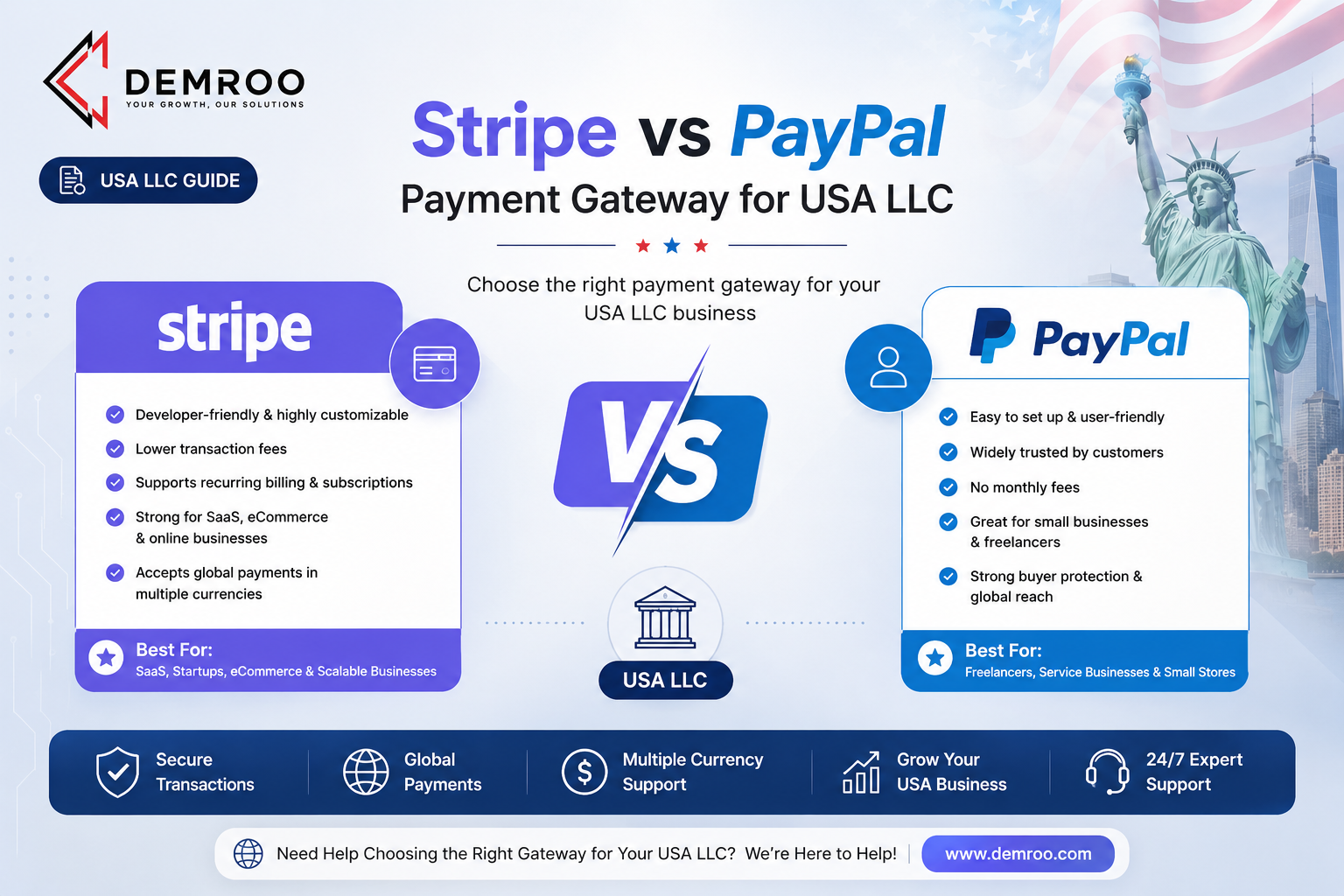
Stripe and PayPal are two of the most widely recognized payment platforms for businesses that want to accept payments online. Both can process card payments, support international transactions, and integrate with websites and e-commerce platforms.
However, they are not identical.
Stripe is often preferred by SaaS companies, subscription businesses, online marketplaces, and brands that need a customizable checkout. PayPal may be more suitable for businesses whose customers prefer paying through a familiar PayPal wallet.
For a non-US resident who owns or plans to form a USA LLC, the right choice depends on more than transaction fees. Business verification, supported countries, website quality, banking arrangements, customer location, chargeback exposure, and the type of products or services being sold can all affect eligibility and performance.
Quick answer: Stripe is generally better for businesses that need customization, subscriptions, APIs, and a branded checkout. PayPal is useful when customers want a familiar wallet-based payment option. Many eligible businesses use both rather than choosing only one.
If you have not yet established your company, review Demroo’s USA LLC formation service before applying for a payment gateway.
What Is Stripe?
Stripe is a payment infrastructure platform that enables eligible businesses to accept credit cards, debit cards, digital wallets, bank-based payments, and other supported payment methods.
Stripe is commonly used by:
- SaaS businesses
- Subscription platforms
- E-commerce stores
- Mobile applications
- Online marketplaces
- Professional service providers
- Startups requiring API-based payment functionality
Stripe provides hosted and customizable checkout options, payment links, invoicing, recurring billing, fraud-management tools, reporting, and developer APIs.
What Is PayPal?
PayPal is an online payment platform that allows eligible merchants to accept payments through PayPal accounts, supported cards, PayPal Checkout, Venmo, Pay Later options, and other available payment methods.
PayPal is commonly used by:
- Freelancers and consultants
- Online retailers
- Small businesses
- International sellers
- Digital-service providers
- Businesses with customers who already use PayPal
One of PayPal’s main advantages is customer familiarity. A buyer can often complete a purchase using an existing PayPal account without entering card information directly on the merchant’s website.
Stripe vs PayPal for a USA LLC: Quick Comparison
| FeatureStripePayPal | ||
| Best suited for | SaaS, subscriptions, apps and customized online stores | Freelancers, online sellers and wallet-based checkout |
| Standard US online payment pricing | Commonly 2.9% + $0.30 for domestic cards | Depends on payment type; PayPal Checkout is commonly 3.49% + a fixed fee |
| International payment charges | Additional fees may apply | Additional international transaction fees may apply |
| Checkout experience | Highly customizable | Recognizable PayPal-branded checkout |
| Subscription tools | Strong billing and subscription features | Recurring payment options available |
| Developer capabilities | Extensive APIs and integrations | APIs and commerce integrations available |
| Customer account required | No | Not always; guest checkout may be available |
| Payment links | Available | Available |
| Fraud tools | Stripe Radar and related tools | PayPal fraud and seller-protection tools |
| Account approval | Subject to verification and eligibility | Subject to verification and eligibility |
| Best overall approach | Primary card-processing platform | Additional wallet and alternative checkout option |
Fees and product availability can change. Always verify pricing on the official Stripe pricing page and PayPal merchant fees page before making a decision.
Can a Non-US Resident Use Stripe With a USA LLC?
A USA LLC can provide the legal business entity needed to apply for a US Stripe account, but forming an LLC does not automatically make the account eligible or guarantee approval.
According to Stripe’s current requirements, a registered business applying for a US account must be registered in the United States. Stripe also requires the physical address where most business activity takes place and states that PO boxes are not accepted for this purpose.
Stripe may verify information including:
- Legal business name
- Entity type
- Employer Identification Number
- Business address
- Business owner or representative
- SSN or ITIN, where required
- Website and business activity
- Bank account information
- Products or services being sold
A registered agent address, virtual mailbox, or LLC formation address may not be accepted as proof of the location where the business actually operates.
Non-US founders should provide accurate information about their real operating location rather than claiming to work from an address that is only used for mail.
For a complete setup overview, read Demroo’s existing guide on how to open Stripe as an Indian.
Can a Non-US Resident Use PayPal With a USA LLC?
A non-US owner may be able to apply for a PayPal Business account, but acceptance depends on PayPal’s current country, identity, business, banking, and compliance requirements.
PayPal may request:
- LLC formation documents
- EIN confirmation
- Owner’s passport or government identification
- Personal residential address
- Business address
- US bank account details
- Business website
- Description of products or services
- Supplier invoices or customer contracts
- Proof of fulfilment
- Expected transaction volume
A USA LLC alone does not override country restrictions or account verification requirements.
The country selected during account creation should accurately reflect the business and account setup. Using incorrect residency, ownership, address, or operational information can lead to payment holds, limitations, or account closure.
Stripe vs PayPal Fees for a US Business
Stripe transaction fees
As of August 2026, Stripe lists a standard rate of 2.9% plus $0.30 per successful domestic card transaction for US businesses using standard online payment pricing.
Stripe also lists additional charges for certain transaction types, including:
- An additional 1.5% for international cards
- An additional 1% when currency conversion is required
- An additional 0.5% for manually entered cards
- A $15 dispute fee, subject to Stripe’s applicable terms and exclusions
The final cost depends on the customer’s card, currency conversion, payment method, account pricing, and additional Stripe products used.
PayPal transaction fees
As of July 15, 2026, PayPal’s published US merchant pricing includes different rates depending on the payment method.
Examples include:
- PayPal Checkout: 3.49% plus the applicable fixed fee
- PayPal Guest Checkout: 3.49% plus the applicable fixed fee
- Standard credit and debit card payments: 2.99% plus the applicable fixed fee
- PayPal Pay Later: 4.99% plus the applicable fixed fee
- Additional international commercial transaction fee: 1.50%
Because PayPal has several payment products, businesses should compare the specific rate that applies to their checkout configuration rather than relying on a single advertised percentage.
Example cost comparison
Consider a $100 domestic US card payment, excluding special account pricing, optional tools, taxes, refunds, and currency conversion.
| Platform and payment type | Approximate published processing fee |
| Stripe domestic online card | $3.20 |
| PayPal standard card payment | Approximately $3.48 with a $0.49 fixed fee |
| PayPal Checkout | Approximately $3.98 with a $0.49 fixed fee |
This simplified example should not be treated as a final quotation. Rates may vary by payment product and can change over time.
Which Platform Provides a Better Checkout Experience?
Stripe checkout experience
Stripe allows businesses to create a checkout experience that feels more closely integrated with their website.
Depending on the integration, customers can pay through:
- Credit and debit cards
- Apple Pay
- Google Pay
- Link
- Bank-based methods
- Supported local payment methods
- Buy Now, Pay Later options
Stripe is usually a strong option when brand consistency and checkout customization are priorities.
PayPal checkout experience
PayPal displays a highly recognizable payment option. Customers with PayPal accounts may be able to pay using saved account information, cards, or linked funding methods.
This familiarity can reduce hesitation among buyers who prefer not to enter card details on an unfamiliar website.
However, a more visibly PayPal-branded checkout may not provide the same level of design control as a customized Stripe implementation.
Which Is Better for Subscriptions?
Stripe is generally the stronger option for complex subscription businesses.
Stripe Billing can support:
- Recurring payments
- Monthly and annual plans
- Free trials
- Usage-based billing
- Coupons and promotional pricing
- Subscription upgrades
- Failed-payment recovery
- Customer billing portals
- Automated invoices
PayPal also supports recurring payments, but Stripe is often more suitable for SaaS platforms and businesses that need detailed billing logic or developer-controlled subscription workflows.
Which Is Better for Freelancers and Service Businesses?
PayPal can be convenient for freelancers whose international clients already use PayPal. It provides familiar invoicing and payment-request functionality.
Stripe may be a better option when the freelancer wants:
- A branded website checkout
- Card payments without requiring a PayPal account
- Automated recurring retainers
- Payment links
- Integration with a booking platform
- More detailed payment automation
A consultant or agency may use Stripe for website payments and keep PayPal as an additional option for clients who specifically request it.
Which Is Better for E-commerce Businesses?
Stripe is often a strong primary processor for e-commerce businesses using platforms that support a direct Stripe integration.
PayPal can be added as a secondary payment method because some buyers specifically look for the PayPal button before placing an order.
Providing both options can give customers more flexibility, but businesses must consider:
- Total integration cost
- Refund processes
- Dispute management
- Reporting complexity
- Cash-flow planning
- Account reserves or holds
- Availability in the target country
The right combination should be based on customer preference and actual sales data rather than assumptions.
Important Challenges for Non-US LLC Owners
1. Payment account approval is not guaranteed
LLC registration, EIN approval, and a US bank account do not guarantee approval from Stripe or PayPal. Each provider carries out independent risk and identity checks.
2. Address verification can create difficulties
A registered agent address is intended to receive legal correspondence. It may not prove where business activity takes place.
Payment providers may request a genuine operating address or supporting documentation.
3. High-risk businesses face additional scrutiny
Some industries are restricted or require prior approval. Examples may include:
- Financial products
- Cryptocurrency services
- Gambling
- Adult services
- Certain health products
- High-risk supplements
- Regulated professional services
- Businesses with delayed fulfilment
Always review the provider’s current restricted-business policy before applying.
4. New accounts may experience payment holds
A processor may delay or reserve part of the balance when an account is new, transaction volume changes suddenly, disputes increase, or fulfilment risk appears high.
5. Currency conversion can increase the total cost
The standard transaction fee may not represent the complete cost. International card charges, cross-border fees, currency conversion, instant payouts, and bank conversion rates can affect the final amount received.
Best Practices Before Applying for Stripe or PayPal
Build a complete business website
The website should clearly show:
- Business name
- Products or services
- Pricing
- Contact information
- Refund policy
- Privacy policy
- Terms and conditions
- Shipping or delivery policy
- Cancellation policy
- Expected fulfilment timeframe
Keep information consistent
The company name, EIN record, bank account, formation document, website, and payment application should use consistent business information.
Explain the business model clearly
Avoid vague descriptions such as “online services” or “general consulting.” Explain exactly what customers purchase, how much they pay, and how the product or service is delivered.
Maintain supporting documents
Keep the following records available:
- LLC formation documents
- EIN confirmation
- Operating agreement
- Owner identification
- Bank statements
- Client contracts
- Supplier invoices
- Proof of delivery
- Customer communications
Do not use inaccurate information
Never use a false address, rented identity, borrowed SSN, unrelated bank account, or another person’s documents. Incorrect information can result in rejection, frozen funds, or permanent restrictions.
Demroo’s payment gateway setup service can help businesses prepare their information and integration correctly. Final approval, however, always remains with the payment provider.
Should a USA LLC Use Both Stripe and PayPal?
For many eligible online businesses, using both platforms can be a practical solution.
Stripe can serve as the primary card-processing system, while PayPal provides an additional wallet-based checkout option.
Using both platforms may help a business:
- Offer more payment choices
- Serve customers with different preferences
- Reduce dependence on one checkout method
- Compare conversion rates
- Support card and wallet payments
- Maintain greater operational flexibility
Using two platforms does not remove compliance requirements. Each account must be independently verified and properly maintained.
Future Trends in Online Payment Processing
Payment processing is moving toward faster checkout, stronger identity verification, automated fraud detection, and more localized payment options.
Non-US founders should expect:
- More detailed beneficial-owner verification
- Greater scrutiny of virtual and mailing addresses
- AI-powered fraud and transaction monitoring
- Wider use of digital wallets
- More localized payment methods
- Stronger website and fulfilment verification
- Increased demand for transparent refund policies
- Continued growth of subscription and usage-based billing
Forming a US company may create access to new business infrastructure, but transparent operations and accurate documentation will remain essential.
Frequently Asked Questions
Is Stripe better than PayPal for a USA LLC?
Stripe is generally better for customized checkout, SaaS billing, subscriptions, APIs, and card payments. PayPal can be valuable when customers prefer a recognizable wallet-based payment option.
Can I use Stripe with a US LLC if I live in India?
You may be eligible to apply, but a US LLC alone does not guarantee approval. Stripe will verify the business, representative, EIN, operating address, website, banking details, and other required information.
Can I open PayPal with a US LLC from India?
You may be able to apply if you satisfy PayPal’s current business, country, identity, address, and banking requirements. Do not select false residency or business information during registration.
Do I need an SSN to open Stripe for a US LLC?
Stripe may request an SSN or ITIN when verifying a US business representative. Requirements depend on the account structure and Stripe’s current verification rules. Check eligibility before forming an LLC solely for Stripe access.
Which platform has lower fees?
For a standard US domestic online card payment, Stripe’s published rate is commonly lower than PayPal Checkout. However, the actual cost depends on payment method, international charges, currency conversion, disputes, and additional services.
Can I connect both Stripe and PayPal to the same website?
Yes, many websites and e-commerce platforms allow eligible businesses to offer both options. Compatibility depends on the website platform and available integrations.
Can Stripe or PayPal hold my money?
Yes. Either provider may place holds, reserves, or account limitations based on risk, disputes, fulfilment concerns, verification issues, or unusual transaction activity.
Does forming a USA LLC guarantee a payment gateway?
No. Company formation and payment gateway approval are separate processes. Stripe and PayPal independently evaluate every application.
Conclusion
Stripe and PayPal can both help a USA LLC receive online payments, but they serve slightly different purposes.
Stripe is usually the better primary option for businesses that need a customizable checkout, subscriptions, advanced integrations, and card-payment automation. PayPal is valuable as an additional payment option for customers who trust and prefer the PayPal wallet.
For many eligible businesses, the strongest approach is to use Stripe as the primary processor and PayPal as a secondary checkout option.
Before applying, ensure that your LLC documents, EIN, banking details, operating address, website, policies, and business description are complete and consistent.
For assistance with USA LLC registration, business bank account setup, and Stripe or PayPal payment gateway setup, contact Demroo.
Disclaimer: This article provides general educational information and does not constitute legal, tax, banking, or financial advice. Stripe and PayPal requirements, pricing, and supported services may change. Always review the provider’s current official terms before applying.
Key Takeaways
- Stripe is generally stronger for customized checkout, SaaS, subscriptions, and developer integrations.
- PayPal provides a familiar wallet-based payment option.
- A USA LLC does not guarantee Stripe or PayPal approval.
- Non-US owners must provide accurate identity, address, banking, and business information.
- Stripe currently lists 2.9% plus $0.30 for standard US domestic online card payments.
- PayPal fees vary depending on the selected payment product.
- International and currency-conversion fees can increase the total cost.
- Eligible businesses may benefit from offering both Stripe and PayPal.